
Can Sonography Detect Cancer? Explanation 2026
Sonography can detect cancer in many parts of the body, and it plays a critical role in modern medical diagnosis. If your doctor recently ordered an ultrasound scan, you are probably wondering what it can and cannot find. This guide covers every important detail about how ultrasound works for cancer detection, which cancers it finds best, and when doctors rely on other imaging tools instead.
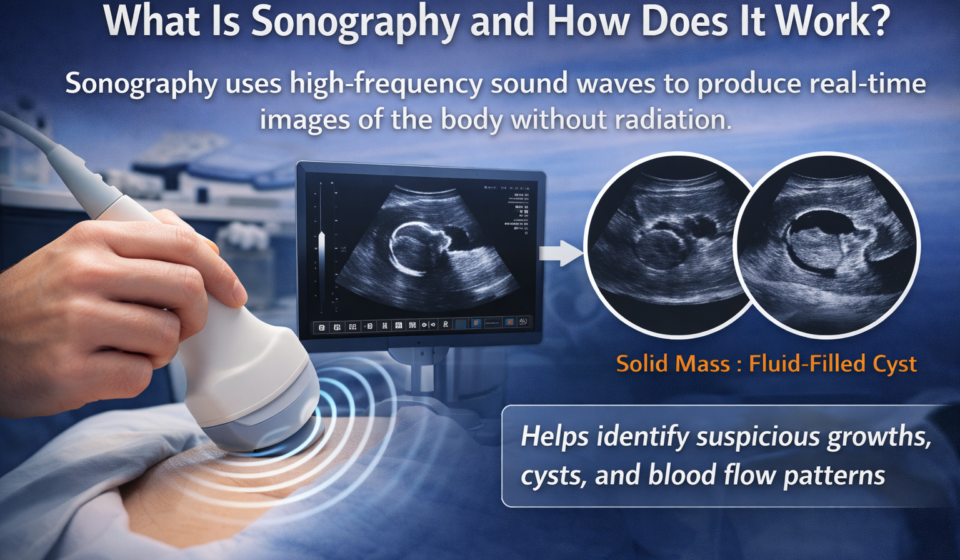
What Is Sonography and How Does It Work?
Sonography is a medical imaging technique that uses high-frequency sound waves. A device called a transducer sends sound waves into your body. Those waves bounce back when they hit different tissues. The machine converts the returning echoes into real-time images on a screen.
Unlike X-rays or CT scans, sonography does not use radiation. This makes it a safe option for repeated use. It works especially well for soft tissues like organs, glands, and fluid-filled structures. Doctors call it an ultrasound scan, a sonogram, or an echo depending on which organ they are examining.
The images appear in black, white, and shades of gray. Solid masses appear differently from fluid-filled cysts. This difference is exactly what helps radiologists spot abnormal growths. A skilled sonographer can identify suspicious shapes, irregular borders, and unusual blood flow patterns that may signal cancer.
Can Sonography Detect Cancer? The Direct Answer
Yes, sonography can detect cancer, but it works better for some cancers than others. It is not a standalone cancer screening tool in most cases. Doctors typically use it alongside biopsies, blood tests, or MRI scans for a complete diagnosis.
The key strength of ultrasound in cancer detection is its ability to distinguish between solid tumors and fluid-filled cysts. A cyst is usually benign. A solid mass with irregular borders and internal blood flow raises suspicion. Doppler ultrasound specifically measures blood flow inside a mass. Cancer cells often create their own blood supply, a process called angiogenesis. Doppler imaging can reveal this unusual blood flow, adding another layer of diagnostic information.
Sonography also guides needle biopsies in real time. A doctor uses the ultrasound image to direct a needle precisely into a suspicious mass. This process, called ultrasound-guided biopsy, significantly improves accuracy and reduces the chance of missing a tumor.
Which Types of Cancer Can Ultrasound Detect?
Ultrasound for cancer detection works exceptionally well for certain organs. Here is a detailed breakdown of the cancers where sonography provides strong diagnostic value.
Breast Cancer
Breast ultrasound is one of the most common uses of sonography in oncology. Doctors use it after a mammogram finds something suspicious. It helps tell apart solid lumps from fluid-filled cysts. Women with dense breast tissue benefit especially from ultrasound because mammograms struggle with dense tissue. Breast ultrasound can detect tumors as small as a few millimeters in the right conditions.
Thyroid Cancer
Thyroid ultrasound is among the most sensitive imaging methods for thyroid abnormalities. It can detect nodules smaller than 5mm. Sonography shows the nodule’s size, shape, echogenicity, and borders clearly. Suspicious features include irregular margins, microcalcifications, and increased blood flow. A dedicated risk classification system called TIRADS helps radiologists assess each nodule accurately.
Liver Cancer
Ultrasound scans the liver effectively for masses and lesions. Hepatocellular carcinoma, the most common form of liver cancer, often develops in people with cirrhosis. Regular ultrasound screening every six months is the standard recommendation for high-risk patients. Contrast-enhanced ultrasound, which uses a safe injectable agent, improves detection accuracy significantly.
Ovarian Cancer
Transvaginal ultrasound provides high-resolution images of the ovaries. It can identify cysts, masses, and other structural changes. Features like solid components inside a cyst, irregular walls, and blood flow signals raise concern. Ovarian cancer is difficult to catch early, and ultrasound plays a key role in evaluating suspicious symptoms.
Testicular Cancer
Scrotal ultrasound is actually the first-line imaging tool for suspected testicular cancer. It is highly accurate for detecting testicular masses. Most solid intratesticular masses that show up on ultrasound turn out to be malignant. The test is quick, painless, and requires no radiation, making it ideal for younger patients.
Kidney Cancer
Renal ultrasound identifies kidney masses that may be cancerous. It differentiates between simple cysts and complex masses that require further investigation. While CT scans provide more detail for kidney tumors, ultrasound often serves as the first step in evaluation, especially when a patient has symptoms or a mass found incidentally during another scan.
Prostate Cancer
Transrectal ultrasound (TRUS) examines the prostate gland. Doctors use it to guide biopsies when PSA levels are elevated. It also shows the size and structure of the prostate. However, prostate ultrasound alone is not reliable enough to diagnose cancer definitively without a biopsy to confirm findings.
Cancers Detectable by Sonography: Quick Reference Table
| Cancer Type | Ultrasound Effectiveness | Key Role of Ultrasound | Commonly Combined With |
|---|---|---|---|
| Breast cancer | High | Distinguishes cysts from solid lumps | Mammogram, biopsy |
| Thyroid cancer | Very High | Detects small nodules, classifies risk | Fine needle aspiration biopsy |
| Liver cancer | High | Screening in cirrhosis patients | Contrast ultrasound, CT, MRI |
| Ovarian cancer | High | Evaluates ovarian cysts and masses | Blood tests (CA-125), MRI |
| Testicular cancer | Very High | First-line test for scrotal masses | Blood tumor markers |
| Kidney cancer | Moderate | Initial detection of renal masses | CT scan, MRI |
| Prostate cancer | Guided biopsy | Guides needle biopsy accurately | PSA test, MRI, biopsy |
| Neck/lymph nodes | High | Detects enlarged or suspicious nodes | Biopsy, CT |
How Doppler Ultrasound Helps in Cancer Detection
Standard ultrasound shows structure. Doppler ultrasound shows blood flow. This difference matters enormously in cancer detection. Tumors generate new blood vessels to feed their rapid growth. This process produces unusual blood flow patterns that Doppler imaging captures in real time.
Color Doppler overlays colored signals onto the grayscale image. Red shows blood flowing toward the transducer. Blue shows flow moving away. A highly vascular mass with chaotic blood flow patterns raises concern for malignancy. Power Doppler is even more sensitive and picks up very slow blood flow inside small tumors.
Spectral Doppler adds numerical data to the evaluation. It measures resistance index and pulsatility index within blood vessels feeding a mass. Malignant tumors often show low resistance index values, reflecting the leaky, chaotic vessels they create. This information gives radiologists another data point when deciding whether a mass needs biopsy.
Limitations of Sonography in Cancer Detection
Understanding what ultrasound cannot do is just as important as knowing what it can do. Sonography has real limitations that every patient and doctor must acknowledge.
Sound waves do not travel well through air or bone. This means ultrasound cannot image the lungs, brain, or bones effectively. Bowel gas also interferes with abdominal scans. A patient who ate recently may have gassy bowels that block clear views of the pancreas or other deep structures.
Body size also matters. Ultrasound waves lose energy as they travel deeper into tissue. In larger patients, deep structures become harder to visualize clearly. Image quality depends significantly on the patient’s body composition.
Operator skill is another important factor. Unlike CT or MRI, ultrasound is highly operator-dependent. The quality of the scan depends heavily on the sonographer’s experience and technique. Two technicians scanning the same patient may produce different results.
Finally, sonography cannot confirm cancer on its own. It identifies suspicious masses, but only a biopsy with histological analysis provides a definitive cancer diagnosis. Ultrasound is a guide, not a verdict.
Ultrasound vs. Other Imaging Modalities for Cancer
Doctors choose imaging tools based on which organ they are examining and what clinical question they need to answer. Ultrasound, CT, MRI, and PET scans each have distinct strengths.
CT scans provide detailed cross-sectional images of the entire body quickly. They are excellent for staging cancer and finding spread to lymph nodes or distant organs. However, CT scans use ionizing radiation. MRI provides superior soft tissue contrast, especially for brain, spinal cord, and liver cancers. It does not use radiation but takes longer and costs more than ultrasound.
PET scans detect metabolic activity. Cancer cells consume more glucose than normal cells. PET picks up this activity even when structural changes are too small to see on CT or MRI. Ultrasound cannot do this. Each modality has its place, and doctors often combine several to get a complete picture of a patient’s condition.
What Happens During an Ultrasound for Cancer Screening?
A typical diagnostic ultrasound appointment takes between 20 and 45 minutes. You lie on an examination table. A sonographer applies a clear, water-based gel to the area being scanned. The gel eliminates air between the transducer and your skin, allowing sound waves to travel smoothly.
The sonographer moves the transducer gently across your skin in different directions. You may feel slight pressure, especially over the liver or pelvic area. The machine captures images throughout the examination. The sonographer may ask you to hold your breath briefly to get clearer images of certain organs.
A radiologist then reviews the saved images and writes a detailed report. Your referring doctor reads the report and discusses findings with you. If the ultrasound finds something suspicious, your doctor will typically order additional imaging, a biopsy, or blood tests to confirm the diagnosis.
Early Cancer Detection and the Role of Ultrasound Screening
Early detection dramatically improves cancer survival rates. Catching a tumor before it spreads to lymph nodes or other organs gives patients far more treatment options. Ultrasound contributes meaningfully to early detection in specific clinical contexts.
Liver cancer screening with biannual ultrasound is widely recommended for people with liver cirrhosis or chronic hepatitis B infection. Thyroid nodule evaluation starts almost universally with ultrasound. Breast ultrasound supplements mammography screening in women with dense breasts, helping radiologists find cancers that mammograms miss. Testicular ultrasound provides rapid, radiation-free evaluation of any testicular lump, catching most cancers at a localized and treatable stage.
However, ultrasound is not appropriate as a general population cancer screening tool for all organs. For lung cancer, chest X-ray or low-dose CT works far better. For colorectal cancer, colonoscopy remains the gold standard. The right tool depends entirely on the specific cancer and the individual patient’s risk factors.
Conclusion
Sonography can detect cancer effectively in several organs including the breast, thyroid, liver, ovaries, and testes. It is safe, affordable, widely available, and radiation-free. Doppler ultrasound adds information about blood flow inside tumors, improving the accuracy of suspicious mass evaluation. Ultrasound-guided biopsy makes tissue sampling more precise and reliable than ever before.
That said, sonography has real limitations. It cannot image through bone or air. It depends on operator skill. And it cannot confirm cancer without a biopsy. The smartest approach is to use sonography as part of a broader diagnostic workup rather than as a standalone answer. If your doctor has ordered an ultrasound scan, trust that they are using the right tool for the right job at the right stage of your evaluation.
Frequently Asked Questions
Q1. Can a normal ultrasound rule out cancer completely?
No. A normal ultrasound result reduces suspicion significantly but does not rule out cancer entirely. Some small or early-stage cancers may not appear on ultrasound. Your doctor may order additional tests if clinical symptoms persist despite a normal scan result.
Q2. Is ultrasound better than MRI for detecting cancer?
It depends on the organ being examined. Ultrasound works better than MRI for thyroid and testicular cancers in terms of speed and cost. MRI provides superior detail for brain, liver, and soft tissue cancers. Doctors often use both together for a complete evaluation.
Q3. Can sonography detect early-stage cancer?
Yes, in specific organs like the thyroid and testicles, ultrasound can detect cancer at a very early stage. For liver cancer in high-risk patients, regular ultrasound screening every six months finds tumors while they are still small and treatable.
Q4. Can ultrasound detect lymph node cancer?
Yes. Ultrasound effectively evaluates superficial lymph nodes in the neck, armpit, and groin. Abnormal features like rounded shape, lost fatty center, and increased blood flow suggest malignancy. A biopsy then confirms the diagnosis.
Q5. Does ultrasound hurt during a cancer screening exam?
Standard external ultrasound is completely painless. You may feel mild pressure when the transducer presses on the skin. Internal ultrasounds like transvaginal or transrectal scans may cause minor discomfort but should not be painful if performed correctly.
Q6. What does a cancerous mass look like on ultrasound?
A cancerous mass often appears as a solid, hypoechoic (darker than surrounding tissue) lesion with irregular or spiculated borders. It may show internal blood flow on Doppler imaging. However, only a biopsy can confirm whether a suspicious mass is truly malignant.
Q7. Can ultrasound detect pancreatic cancer?
Ultrasound can sometimes detect pancreatic masses, but bowel gas frequently blocks the view. CT scan and MRI provide far better visualization of the pancreas. Endoscopic ultrasound, where a probe is placed inside the digestive tract, gives much clearer pancreatic images.
Q8. How often should a high-risk patient get a liver ultrasound?
International liver cancer guidelines recommend ultrasound screening every six months for people with cirrhosis or chronic hepatitis B. This interval balances the goal of catching tumors early with the practical limits of healthcare resources and patient convenience.
Q9. Can sonography detect bone cancer?
Ultrasound does not penetrate bone, so it cannot image primary bone tumors directly. However, it can detect soft tissue masses around bones and help evaluate the extent of tumor spread into adjacent soft tissues. MRI and X-ray are the preferred tools for bone cancer evaluation.