
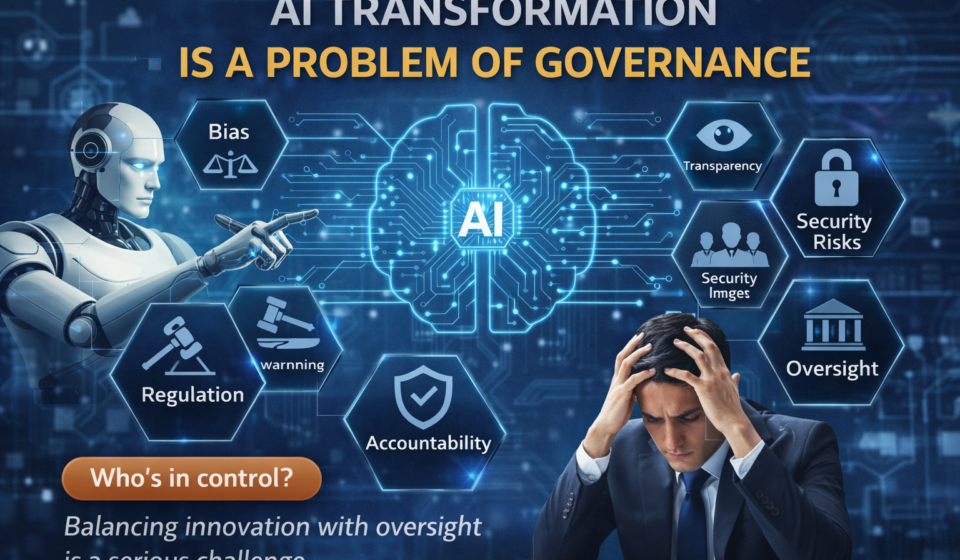
AI Transformation Is a Problem of Governance | Fix It
| Governance Gap | What It Means | Real-World Impact | Risk Level |
|---|---|---|---|
| No Clear Accountability | Nobody owns AI decisions inside the org | Blame shifts when AI causes harm or errors | High |
| Missing AI Ethics Policy | No written rules on fairness, bias, or usage | Discriminatory outputs go unchecked | High |
| Weak Data Governance | AI trains on unvetted or sensitive data | Privacy breaches and compliance failures | High |
| No Human Oversight Loop | AI runs decisions without human review | Automated errors scale before detection | Medium-High |
| Regulatory Non-Compliance | AI systems don’t meet legal standards | Fines, lawsuits, operational shutdowns | Medium-High |
| Employee AI Literacy Gap | Staff don’t understand how AI makes choices | Misuse, overtrust, or fear of AI tools | Medium |
| No AI Audit Framework | Systems never checked for drift or errors | Performance degrades silently over time | Manageable |
Introduction: The Real Blocker Is Not Technology
Everyone talks about AI like it is a technology problem. But the truth? AI transformation is a problem of governance, and organizations are finally learning this the hard way. Companies pour millions into AI tools, machine learning platforms, and automation systems. Yet many still fail to see results. The tools work fine. The real issue is who controls them, who is responsible for them, and what rules guide their use.
Governance is the missing layer in most AI strategies. It is the difference between AI that drives real value and AI that creates chaos, legal risk, and public distrust. This article breaks down exactly why governance is the core challenge of AI transformation and what you can do about it.
What Does AI Transformation Actually Mean?
AI transformation means rebuilding how a business operates using artificial intelligence. It goes far beyond automating a task here or there. True AI transformation changes decision-making, customer experience, hiring, finance, product development, and more.
Organizations that pursue AI transformation are trying to become data-driven at every level. They want systems that learn, adapt, and improve on their own. This sounds exciting, but it creates massive questions about oversight. Who decides what the AI can do, Who checks if it is working fairly and Who steps in when it goes wrong?
These questions are not technical. They are governance questions.
Why Governance Is the Core Problem
AI Creates Decisions That Need Accountability
When a human makes a bad decision, you can trace it back. There is a person, a record, a reason. When AI makes a bad decision, things get murky fast. The algorithm runs on data. The data came from somewhere. The model was trained by someone. And none of these parties want to take blame.
This is the accountability vacuum at the heart of AI transformation. Without governance, nobody owns the outcome. And when nobody owns the outcome, problems multiply. Governance frameworks assign clear ownership. They say who signs off on AI outputs and who answers when something goes wrong.
Data Is the Foundation, and It Needs Rules
AI systems live and die by their data. Bad data in means bad decisions out. But most organizations have very poor data governance. Data sits in silos. Different teams use different definitions. Nobody checks if training data is biased or outdated.
Strong AI governance starts with strong data governance. Organizations need rules about what data AI can use, how long it can store data, and who can access it. Without these rules, AI transformation builds on a shaky foundation. Regulatory bodies like the EU’s GDPR already demand this. Many companies are simply not ready.
Bias and Fairness Cannot Be Ignored
AI systems learn patterns from historical data. If that historical data reflects past biases, the AI will reproduce those biases at scale. This is not a theory. It has already happened in hiring, lending, law enforcement, and healthcare.
Without governance, nobody audits these systems for fairness. There is no policy that forces a check on who gets approved for a loan or who gets shortlisted for a job. AI runs on autopilot, and bias becomes invisible and systemic. Responsible AI governance demands regular fairness audits. It requires diverse teams reviewing model outputs. It insists on transparency in how decisions are made.
Regulation Is Coming, Ready or Not
Governments around the world are moving fast on AI regulation. The EU AI Act is already shaping compliance requirements for companies operating in Europe. The United States is drafting sector-specific rules. Countries like China, Canada, and the UK are building their own frameworks.
Organizations that build AI governance now will be ready. Those that ignore it will scramble to retrofit compliance into systems that were never designed for it. Retrofitting is expensive. It is slow. And it often breaks things that already work. Building governance-first saves enormous pain later.
The Table Above Explains the Key Governance Gaps
(See the table displayed above for a full breakdown of governance gaps, their meaning, real-world impact, and risk level.)
What Good AI Governance Looks Like
Clear Ownership and Accountability Structures
Every AI system needs an owner. Not a department, a person. Someone who reviews its performance, answers for its failures, and ensures it stays aligned with company values. Many organizations create a Chief AI Officer or an AI Ethics Board for this reason.
This person or team sets the rules for how AI is deployed. They approve new AI use cases, they review incidents and they report to leadership on AI risk. Without this structure, AI sprawls across the organization with no unified direction and no consistent standards.
Written AI Ethics Policies
An AI ethics policy is a living document. It spells out the values your organization applies to AI use and it covers fairness, transparency, privacy, safety, and human oversight. Also it is not a legal document full of jargon. It is a practical guide that every team member can understand and use.
Building this policy requires cross-functional input. Legal, HR, product, engineering, and leadership all need seats at the table. The policy should cover what AI can decide on its own and what always needs a human review. It should also include a process for raising concerns about AI outputs.
Human-in-the-Loop Systems
Not every AI decision should be final. High-stakes decisions need human review. A loan rejection, a medical diagnosis flag, or a hiring shortlist all carry real consequences. Governance defines where human judgment is required and where automation can run freely.
Human-in-the-loop design is not about distrust of AI. It is about appropriate oversight, adds a check that catches errors before they become disasters and also builds user trust. People are more comfortable with AI decisions when they know a human reviews outcomes that affect them directly.
Regular Auditing and Monitoring
AI models drift over time. The world changes. Data patterns shift. A model that worked well last year may make poor decisions today. Without auditing, you never know until something goes badly wrong.
Good governance includes a regular audit schedule. Teams check model accuracy, fairness, and alignment with business goals. They test for unexpected bias. They compare outputs against real-world results. This is not a one-time task. It is an ongoing commitment that keeps AI systems trustworthy and reliable.
AI Governance Across Different Industries
Healthcare
In healthcare, AI governance is literally life-or-death. AI tools help diagnose disease, recommend treatment, and manage patient records. A poorly governed AI system could recommend the wrong drug or misread a scan. Healthcare AI governance requires strict data privacy rules, clinical validation of outputs, and clear protocols for when AI assists versus when it decides.
Finance
Financial AI makes lending decisions, detects fraud, and manages investment portfolios. Governance here means auditable decision trails, fair lending compliance, and stress-tested models. Regulators like the SEC and OCC are already asking financial institutions to demonstrate AI accountability. Organizations without governance structures face serious regulatory exposure.
Human Resources
AI in HR handles resume screening, performance reviews, and even promotion recommendations. The risk of bias here is enormous. Governance demands bias testing of screening algorithms, human review of final hiring decisions, and transparent communication with candidates about how AI shapes their evaluation.
Common Mistakes Organizations Make
Many organizations rush into AI transformation without governance in place. They buy the tools first and think about rules second. This leads to predictable failures.
Some companies treat governance as a compliance checkbox. They write a policy, put it in a drawer, and forget it. Real governance is active, not passive. It requires regular reviews and updates as AI capabilities and regulations evolve.
Others assign AI governance to IT alone. Technology teams understand the systems but often lack the ethical, legal, and business context needed to govern well. Governance must involve diverse voices across the entire organization.
Finally, some companies fear that governance will slow down AI adoption. In reality, good governance speeds things up in the long run. It reduces rework, prevents costly failures, and builds the trust needed for employees and customers to embrace AI tools.
How to Build an AI Governance Framework: Step-by-Step
Step 1: Audit your current AI use. Map every AI tool your organization uses today. Note what decisions each tool influences and who manages it.
Step 2: Identify governance gaps. Use the gap analysis table above as a reference. Find where accountability, data rules, and ethics policies are missing.
Step 3: Appoint an AI governance lead. This can be a dedicated role or an existing leader with expanded responsibility. Give them authority to set and enforce standards.
Step 4: Write your AI ethics policy. Involve legal, HR, product, and engineering. Keep the language clear and practical. Define human oversight requirements explicitly.
Step 5: Build an audit schedule. Decide how often each AI system gets reviewed, who reviews it, and what criteria determine success or concern.
Step 6: Train your people. Governance only works if people understand it. Run training sessions. Share real examples of what good AI governance looks like in practice.
Step 7: Review and update regularly. Set a quarterly or biannual review cycle. Update policies as regulations change and as your AI capabilities grow.
The Business Case for Prioritising Governance
Governance is not just about risk reduction. It is a competitive advantage. Organizations with strong AI governance build customer trust faster. They attract talent who want to work somewhere with clear ethical standards. They avoid the massive reputational and legal costs of AI failures.
Research consistently shows that consumers trust AI-powered services more when companies are transparent about how AI is used. Transparency is a governance output. It comes from having clear rules, honest communication, and accountability structures in place.
Investors are also paying attention. ESG frameworks now increasingly include AI governance as a factor in corporate responsibility scoring. Organizations that govern AI well score better on governance metrics, which influences investment decisions.
Conclusion: Governance Is Not Optional Anymore
The era of deploying AI first and governing it later is over. We now know that AI transformation is fundamentally a problem of governance, not a technology shortcut. The organizations that will win with AI are not those with the most sophisticated models. They are the ones who know who owns those models, what rules guide them, and how to catch problems before they explode.
Governance is the infrastructure of responsible AI transformation. It is the difference between AI that earns trust and AI that destroys it. Start building your governance framework now. The cost of waiting is far higher than the cost of starting.
Frequently Asked Questions (FAQ)
Q1: What is AI governance and why does it matter?
AI governance is the set of policies, roles, and processes that guide how AI systems are built and used. It matters because AI makes decisions that affect people, and someone must be responsible for those decisions.
Q2: How is AI transformation different from just using AI tools?
AI transformation means redesigning core business processes around AI capabilities. Using AI tools is a starting point, but transformation requires culture, strategy, and governance to work at scale.
Q3: What are the biggest risks of poor AI governance?
The biggest risks include biased outputs, legal non-compliance, data privacy breaches, reputational damage, and unchecked automated errors that grow before anyone notices them.
Q4: Who should own AI governance inside a company?
AI governance needs a dedicated lead, often a Chief AI Officer or an AI Ethics Board. This role must have authority across departments, not just sit inside IT or legal.
Q5: How does the EU AI Act affect AI governance?
The EU AI Act classifies AI systems by risk level and sets strict rules for high-risk applications. Organizations must document, test, and demonstrate accountability for AI systems that fall under its scope.
Q6: Can small businesses afford AI governance?
Yes. Governance does not have to be complex or expensive. Small businesses can start with a simple AI use policy, assign one person as the AI point of contact, and build from there as they grow.
Q7: What is a human-in-the-loop AI system?
It is an AI system designed so that a human reviews or approves decisions before they take effect. This adds a safety check and is especially important in high-stakes areas like healthcare, hiring, or credit decisions.
Q8: How often should AI systems be audited?
At minimum, annual audits are recommended for low-risk systems. High-risk or high-frequency AI systems need quarterly reviews to catch model drift, bias, or performance issues early.
Q9: Does good AI governance slow down innovation?
In the short term, governance adds steps. But it prevents the costly failures and rework that come from ungoverned AI. Long-term, it accelerates adoption by building the trust that employees and customers need to embrace AI tools.