eClinicalWorks EMR: Features, Pricing & Full Review 2026
In healthcare, you have definitely heard of its name. This electronic medical record system was created back in 1999, founded in Massachusetts. The software became extremely popular nationwide. There are more than 180,000 physicians using eClinicalWorks EMR. In total, over 850,000 medical professionals in the United States were exposed to the software.
That kind of reach does not happen by accident. The platform built its reputation by solving a problem that was genuinely painful for smaller practices: getting off paper records and onto a connected digital system without spending a fortune to do it.
Now it does more than just storing records. Scheduling, clinical documentation, billing, telehealth solutions, AI-powered documentation, and population health management – all of these features are now offered by eClinicalWorks. It wants to be your single solution, which is both impressive and exhausting for a single healthcare IT product.
Is eClinicalWorks an EHR or an EMR?
This question often comes up in the healthcare IT community, and it’s not surprising, considering how often these two terms are used interchangeably.
Let me break it down.
EMR stands for Electronic Medical Record. It is basically the digital version of your patient’s chart. Your physician would open it up, read what is written there, document the appointment in their own words, and close the record afterward.
An EHR does more than that. It is built to exchange data between doctors, clinics, specialists, and insurance companies. Your medical file is portable. In addition, you yourself will be able to sign on and review your records.
Which one is eClinicalWorks, then?
Both, honestly. It handles clinical documentation the way a traditional EMR does, but it also supports cross-provider data sharing and patient-facing tools that qualify it as a full EHR. It carries ONC certification to back that up.
The reason most people still call it eClinicalWorks EMR is simply because that is what the industry called it for years and old habits stick. When you hear either term used for this platform, they are pointing at the same thing.
What the Platform Actually Does Day to Day
Before any practice commits to a system like this, it is worth understanding what you are actually buying. Here is how the main pieces work in practice.
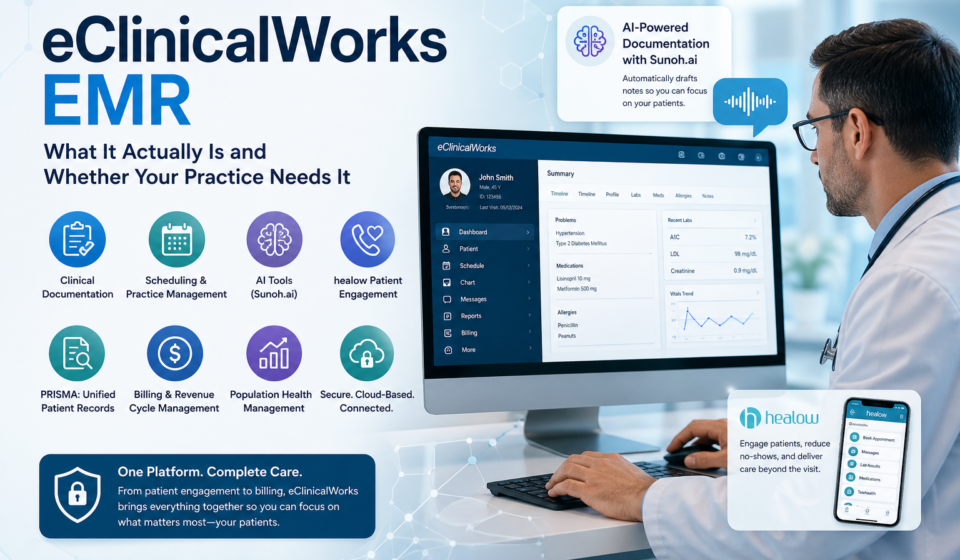
Clinical Documentation
The charting system gives providers customizable templates across more than 50 medical specialties. Cardiology, neurology, OB/Gyn, podiatry, behavioral health — each has its own structure so you are not starting from a blank page every time.
Doctors can input notes via touch screen, voice commands, keyboard typing, or a combination of all three. After it gets used to your style of inputting, it starts saving you time by filling out the drop-down boxes and quick links for you. The monitor displays all of the patient’s history at once, from previous visits to current prescriptions to allergies to laboratory tests.
AI Tools: Sunoh.ai and Beyond
This is where eClinicalWorks has made its most notable moves recently. The platform now integrates Sunoh.ai, an ambient AI scribe that listens to the conversation between provider and patient during the visit and automatically drafts the clinical note. The physician never has to type while the patient is in the room.
There is also what the company calls a conversational EHR, where providers use natural language to search records, schedule patients, or complete documentation tasks. And an Image AI tool handles incoming faxes automatically, matching them to the right patient and extracting the relevant content so front desk staff do not have to do it manually.
None of this is theoretical anymore. These tools are in active use across practices that have adopted them.
Scheduling and Practice Management
The scheduling tool integrates seamlessly with the practice management component of the platform. This provides a process flow that starts from booking appointments and goes all the way to billing in a single system. Color-coded calendar options, custom views, and automated reminders using the eClinicalMessenger utility. Over 50 million patient communications are sent out each year by the software. That will give you an idea of how much it is in use.
Healow Patient Application
Patients utilize the healow application for making appointments, refill requests, reviewing laboratory reports, communicating with their providers, and joining telemedicine consultations. Over 2.5 million telemedicine sessions have been facilitated using the platform on an annual basis. It is among the best tools to minimize no-shows and engage patients in between consultations.
PRISMA: Pulling Records from Everywhere
PRISMA is a health information search engine built into the platform. It pulls together a patient’s medical history from primary care, specialists, urgent care, hospitals, insurers, and even wearable devices, then displays it as a searchable timeline right at the point of care. The system exchanges more than 2.6 million patient records daily with other EHR vendors.
For patients who see multiple providers, this kind of real-time aggregation changes what a physician can know before making a clinical decision.
Billing and Revenue Cycle
This software will code ICD-10 codes, submit electronic claims, check eligibility, and post payments. Those practices who do not wish to maintain their billing themselves may choose to outsource their entire revenue cycle management to eClinicalWorks. This software will take care of everything from coding to collections.
Who is the Target Audience of This Software?
eClinicalWorks EMR is intended for ambulatory care facilities.Outside of hospital walls is where it works best.
It fits primary care and family medicine practices that want a single system covering everything. It works well for small to mid-sized specialty practices in cardiology, dermatology, orthopedics, and behavioral health because the specialty templates are already built. Federally Qualified Health Centers with large patient populations use it for the population health tools. Multi-location group practices use it because the cloud-based architecture runs everything on one database regardless of how many sites you have.
If you are running a large hospital system or academic medical center, eClinicalWorks is probably not the right conversation. Epic owns that segment. But when it comes to outpatient and ambulatory services, eClinicalWorks emerges as one of the leading companies in the nation along with athenahealth.
What Does It Cost?
Pricing transparency has never been eClinicalWorks’ strongest suit, but here is what is broadly reported across the industry.
The core EHR and practice management bundle typically starts around $449 per provider per month. Total costs climb from there depending on how many providers you have, which add-on modules you need, and what transaction-based fees accumulate over time. Virtual visit charges and lab integrations can add up in ways that make the monthly bill less predictable than the base subscription suggests.
Training requirements are worth understanding before you start. Providers generally need 12 to 16 hours of training. Billers around 12 hours. Front office staff around 8. Skipping this step is one of the most common mistakes practices make and it tends to cause problems for months afterward.
eClinicalWorks offers a free demo. Take it. It is worth the time before any contract conversation happens.
One thing to read carefully before signing: the cancellation process. Long-term commitment to contract terms and difficult withdrawals are among the top complaints of practices who have been involved in exiting the platform. Be informed about what you will be committing yourself to before you do so.
The honest picture of eClinicalWorks EMR is more complicated than a simple thumbs up or thumbs down.
Providers who have invested in proper implementation tend to like it. The depth of features is real. The flexibility across specialties is genuinely useful. The AI tools are generating real interest among physicians who are tired of spending evenings catching up on documentation. The scheduling and billing integration reduces the friction of running a practice on multiple disconnected systems.
The complaints cluster around a few specific areas. Customer support is the most common one. Reaching a helpful person quickly is not always easy, and offshore support teams with response time issues come up frequently in user reviews. The cancellation process is another consistent complaint, with some practices reporting six months or more to complete an exit. And the total cost of ownership tends to be higher than the base subscription price implies once all the add-ons are included.
The platform rewards preparation. Practices that go in with proper training, realistic expectations about pricing, and a clear-eyed read of the contract tend to do well. Practices that rush implementation consistently struggle.
How It Compares to the Alternatives
In ambulatory EHR, the two biggest cloud-based platforms are eClinicalWorks and athenahealth. Athenahealth consistently rates well for independent physician practices and is particularly strong in revenue cycle management. eClinicalWorks holds the largest cloud ambulatory install base in the country and is investing more heavily in AI features.
Epic dominates hospital and large health system contracts, capturing around 70 percent of new hospital EHR deals in 2024. For an outpatient clinic, Epic is generally overkill and significantly more expensive.
Practices specializing in dermatology, behavioral health, and orthopedic cases should give consideration to NextGen Healthcare following their acquisition by Thoma Bravo.
It would not be an exaggeration to say that what makes eClinicalWorks unique among all the other platforms in the field is its AI development program and its current number of users. The presence of 180,000 doctors on the platform ensures access to trained professionals and third parties in the ecosystem.
Conclusion
eClinicalWorks EMR is a solid EMR with comprehensive clinical documentation capabilities, scheduling, billing, artificial intelligence scribe, telemedicine functionality, and interoperability in one convenient cloud-based software package.
While not flawless, having unreliable customer service and requiring one to examine the contract terms, the investment in artificial intelligence technology combined with wide specialties and cloud convenience may make this solution worth considering for any outpatient practice regardless of its size and specialty type.
One can hardly overstate the importance of one factor which defines success in implementing the solution – proper preparation. Those practices that prepare sufficiently, learn about their contract and spend money wisely achieve outstanding performance with the product. This trend has been observed consistently among those who use the software efficiently.
Frequently Asked Questions
Is eClinicalWorks EMR an EHR or EMR?
eClinicalWorks EMR is technically both an EHR and an EMR. It enables clinical documentation for one practice similar to other EMRs, but its data exchange and patient engagement capabilities also fit the requirements of an electronic health record. Even though eClinicalWorks positions its product as an EHR certified by the Office of National Coordinator, most people prefer the old name.
What are the applications of eClinicalWorks EMR?
Patient scheduling, documentation, e-prescription, laboratory and radiology services, billing, telemedicine, population health management, and patient engagement tools. Its functionalities range from scheduling appointments to managing payments.
How expensive is eClinicalWorks EMR?
Its base bundle usually ranges from $449 per provider monthly. Depending on other factors such as additional software modules, transaction fees, implementations, and training, the cost can vary. To get an exact quote, request it.
Is eClinicalWorks suitable for small practices?
Yes. It was designed for mid-sized and small ambulatory practices in its early stages but remains effective in its current form. Cloud hosting services, affordable pricing, and specialty templates make it ideal for solo practitioners and small clinics.
Which specialties does eClinicalWorks support?
Over 50 medical specialties, some of which include primary care, cardiology, neurology, OB/Gyn, mental health specialists, dermatology, orthopedics, podiatry, and dental practices.
Is eClinicalWorks equipped with AI technology?
Yes. Sunoh.ai enables automatic conversion of provider-patient dialogue into preliminary clinical notes. Generative AI is responsible for processing voice command queries. Image AI analyzes images from incoming fax transmissions.
How long does implementation take?
Implementation time varies based on the size and complexity of practice. The training process itself lasts between 8 to 16 hours depending on role. The preparation for full go-live implementation usually takes a few weeks to several months.
Is patient access to their records possible?
Yes, they have access via healow application and patient portal to look at records, request prescription refills, schedule appointments, communicate with medical staff and participate in telehealth visits.
Is eClinicalWorks HIPAA compliant?
Yes. The platform runs on Microsoft Azure infrastructure with encryption and secure login protocols in place.