
Major Trends in Technology 2026 | What’s Changing and Why It Matters
Technology in 2026 is far removed from its portrayal just a few years ago.
Gone are the days of flying cars and science fiction. The innovations currently emerging are subtler yet no less transformative. Artificial intelligence is creeping into your familiar apps. Robotic systems are working real shifts in real warehouses. Even the processes behind software development, scientific discovery, and business management are being fundamentally transformed.
For those interested in learning about the technologies worth following this year, look no further than this guide. No buzzword gimmicks. No fluff. Only the top technology trends in 2026 proven to be driving change, as highlighted by leading organizations such as Gartner, IBM, Microsoft, MIT, and Deloitte.
What Are the Major Technology Trends in 2026?
Agentic AI, Physical AI, Multiagent Systems, AI-driven Cybersecurity, Cloud 3.0, Open Source AI models, and AI in Scientific Discovery are the biggest technology trends of 2026. Each one of these innovations will move beyond experimental pilots into widespread implementation during 2026.
1. Agentic AI
Last year, AI meant typing in your query and receiving an answer. This type of AI is already old-fashioned.
In 2026, AI does not respond only after you enter a query. AI decides, makes plans, and executes actions independently. Imagine booking an appointment, sending reminders through email, processing workflows, or even operating a small enterprise without having to click on each button yourself.
Multiagent Systems were selected by Gartner as one of its key strategic technology trends for 2026. Microsoft has characterized the trend as an evolution from AI responding to questions posed by humans to collaborating with them in real-life situations.
A good example would be how three people can now coordinate a global marketing campaign in just days. The AI handles data, content creation, and targeting. The humans handle the strategy and final decisions.
For freelancers in Pakistan, this is already relevant. Tools like Claude and ChatGPT are adding more agentic features every few months. Learning to use them well is becoming a real skill that clients will pay for.
2. Physical AI
AI tends to be considered something that operates from behind a computer screen. In 2026, this is about to change.
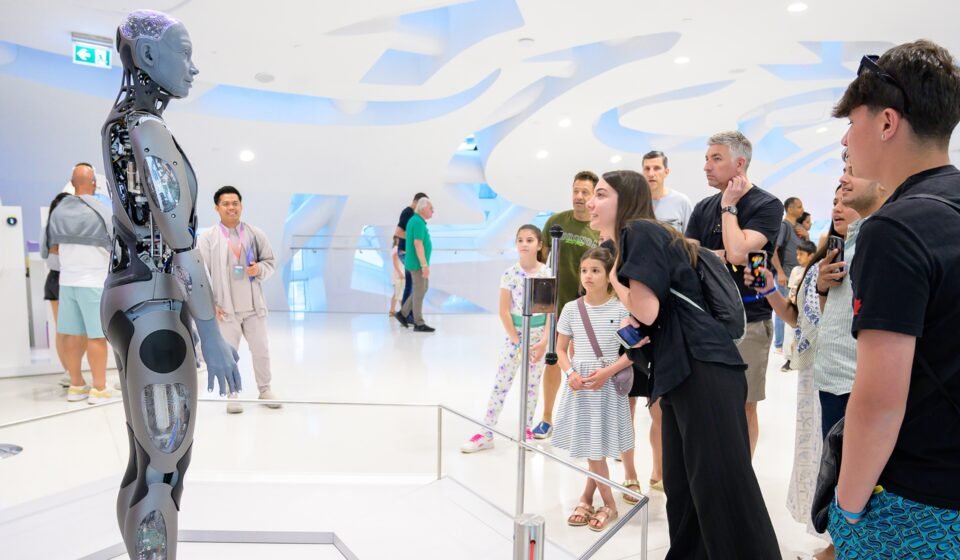
Physical AI refers to intelligence that now powers robots, drones, and machines operating in the real world. Amazon crossed one million robots in its warehouses. BMW has cars driving themselves through production lines inside factories. Humanoid robots moved from demo videos into actual pilot programs in 2025 and are expanding further this year.
This matters because it is not just a tech story. It is a supply chain story, a logistics story, and eventually a jobs story. The companies building and using Physical AI right now are getting a head start that will be very difficult to close later.
3. Multiagent Systems
Here is something most people have not thought about yet.
The future of AI is not one very powerful model doing everything. It is many specialized AI agents working together as a team. One handles research. Another writes. Another reviews and checks for errors. They coordinate automatically.
Gartner describes this as modular AI agents collaborating on complex tasks to improve automation and scalability. Deloitte points out that only 11 percent of organizations have AI agents in actual production today, even though 38 percent are running pilots. That gap is closing in 2026.
For developers and tech businesses, understanding how to build and manage these systems is quickly becoming one of the most valuable skills available.
4. AI and Cybersecurity
Cybersecurity has been a game of cat and mouse since its inception. But in 2026, both have resorted to the power of artificial intelligence.
AI is being used by attackers to detect vulnerabilities, to send highly believable phishing emails and also to carry out automated cyber attacks. The only way to stop these attacks is through AI-based threat detection mechanisms.
IBM surveyed executives and found that 93 percent believe managing their own AI systems and data, what IBM calls AI sovereignty, will be essential for business strategy in 2026. Security is a core part of that.
For any business operating online, this is not a future concern. It is a current one.
5. Cloud 3.0
Most businesses have spent the past decade building their cloud infrastructure to protect their data. It was built for storing files, running apps, and handling traffic. It was not built for the economics of running AI at scale.
Cloud 3.0 is the response to that problem. It combines hybrid cloud, multi-cloud, and sovereign cloud architectures specifically designed to support AI workloads without the costs and limitations of older systems.
Capgemini explains that the shift occurs when organizations change their focus from cloud-first to AI-first architecture, which demands a complete redesign of the existing system rather than an upgrade.
From a developer’s perspective, expertise in these architectural designs has already become evident in job descriptions.
6. Open Source AI
Not long ago, serious AI meant expensive API access and massive computing budgets. That is shifting quickly.
In 2026, smaller open source models are matching the performance of larger proprietary ones in specific tasks. IBM’s Granite, Meta’s Llama models, and DeepSeek are all examples of this. IBM’s Director of Open Source AI says smaller reasoning models that are multimodal and easier to fine-tune for specific domains will become standard this year.
What this means practically is that a developer in Lahore or Rawalpindi can now access genuinely powerful AI models without paying enterprise-level fees. This is one of the more quietly significant shifts of 2026 for people building things outside major tech hubs.
7. AI in Scientific Discovery
This one does not affect most people directly today, but it will within the next few years.
AI is not just helping scientists search through existing research faster. It has started testing its own theories and solving problems in areas such as healthcare, climate studies, and material science.
Peter Lee, President of Microsoft Research, described it clearly: “In 2026, AI will actively participate in discovery work in physics, chemistry, and biology, along with human scientists rather than just assisting them.”
New medicines and better battery technology are two areas where this is already producing results that would have taken much longer using traditional research methods.
Comparison Table: Major Trends in Technology 2026
| Trend | Who It Affects Most | Timeline |
|---|---|---|
| Agentic AI | Freelancers, businesses, everyone | Right now |
| Physical AI | Manufacturing, logistics, retail | Now and expanding |
| Multiagent Systems | Developers, tech companies | Now, growing fast |
| AI Cybersecurity | All businesses online | Urgent, right now |
| Cloud 3.0 | IT teams, developers | Ongoing transition |
| Open Source AI | Developers, freelancers | Right now |
| AI in Science | Healthcare, research | 2 to 5 year impact |
Most Frequently Asked Questions
What is the primary technology trend of 2026?
The most important trend in technology this year is Agentic AI. This is an approach that allows an AI to work independently without the need for human interaction.
Are these trends going to impact employment opportunities in Pakistan?
Yes, but not in such a catastrophic way as it might seem at first glance. The point here is that people who can use different tools offered by Artificial Intelligence are increasingly becoming more efficient and more desirable as potential employees.
Which trends are crucial for the work of a freelancer?
Agentic AI and Open Source AI would be especially beneficial for freelancing. They allow people who master these technologies to boost their efficiency and productivity.
According to Gartner, which is the most important technology trend for 2026?
As per Gartner’s predictions, the most important technology trends for 2026 include Multiagent Systems, Domain-Specific Language Models, and Physical AI.
Is AI going to substitute software developers in 2026?
Certainly not. On the contrary, GitHub reported that developer activity in the year had surged by 23% reaching a record number of one billion commits.
What to Take Away
The major trends in technology in 2026 are not waiting for anyone to get ready.
Agentic AI is already in the tools you use. Physical AI is already on warehouse floors. Open source models are already available for free. The question is not whether these things are happening. It is whether you are paying attention early enough to benefit from them.
Start with one thing.Choose a tool, a trend, and a skill set. Master it. This is how people anticipate such changes, not through omniscience, but through early action before everyone realizes that they ought to.
Last Updated: April 2026 | References: Gartner, IBM, Microsoft Research, Deloitte, MIT Technology Review, Capgemini