

Ai contextual governance business evolution adaptation
Introduction
Every business today faces one undeniable truth. AI is not optional anymore. The rise of ai contextual governance business evolution adaptation has changed how companies operate, make decisions, and stay competitive. Businesses that ignore this shift fall behind fast. Those that embrace it grow smarter, faster, and more resilient. But adopting AI is only half the story. The real challenge is governing it wisely, in context, and in real time. This article breaks down everything you need to know. You will understand what contextual AI governance means, why it drives business evolution, and how your organisation can adapt successfully.
What Is AI Contextual Governance?
AI contextual governance is a dynamic approach to managing artificial intelligence systems. It goes beyond static rulebooks, reads the environment and adjusts AI behaviour based on real-time business context. Think of it as a living policy engine. It continuously monitors what is happening inside and outside the organisation. Then it applies the right rules at the right moment.
Traditional governance was rigid. A rule was a rule. But business environments shift constantly. Regulations change. Customer behaviour evolves. Market conditions move overnight. Contextual AI governance responds to all of this automatically. It keeps AI systems aligned with current reality, not yesterday’s assumptions.
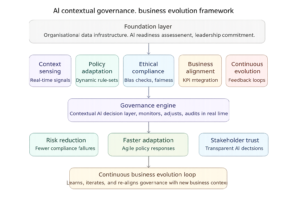
This approach combines three core ideas. First, awareness of context. Second, the ability to adapt policy. Third, continuous alignment with business goals. Together, these create a governance system that grows with the organisation.
Why Context Matters in AI Governance
Context is everything in intelligent decision-making. An AI system without contextual awareness makes blind decisions. Imagine a healthcare AI that applies the same policy for patient data in an emergency as it does in routine admin. That is dangerous. Context changes the rules entirely.
In business, context includes market conditions, regulatory environments, customer expectations, and internal operations. An AI governance framework that reads all of these inputs becomes genuinely intelligent. It stops being a compliance checklist. It becomes a strategic tool.
Contextual awareness also prevents bias amplification. When AI systems understand the situation fully, they make fairer decisions. They avoid applying outdated logic to new circumstances. This protects both the business and the people it serves.
The Five Pillars of AI Contextual Governance
1. Context Sensing
Context sensing is the first pillar. It means building AI systems that constantly read their environment. They monitor regulatory updates, market signals, and internal performance data. This real-time awareness feeds the rest of the governance engine. Without it, the entire system operates blind.
Good context sensing uses multiple data streams. It combines internal KPIs, external news feeds, regulatory databases, and customer sentiment analysis. The AI governance layer processes all of this simultaneously. It detects when a shift has occurred. Then it flags the relevant policies for review or automatic adjustment.
2. Policy Adaptation
Static policies break under pressure. Policy adaptation is the second pillar. It means governance rules are not locked in stone. They respond to new information automatically. When context changes, policies adjust to match.
This does not mean governance becomes lawless. Human oversight remains essential. But the speed of adaptation improves dramatically. A business facing a sudden regulatory change does not wait weeks for a policy committee. The AI governance framework flags the issue, suggests updated rules, and escalates to human reviewers within hours.
3. Ethical Compliance
Ethical compliance is the third pillar and one of the most critical. AI systems can cause harm if left unchecked. Bias in hiring algorithms, discriminatory loan approvals, and privacy breaches are all real risks. A strong governance framework builds ethics directly into the decision layer.
This pillar includes regular bias audits, transparency requirements, and fairness checks. Every AI decision should be explainable. If a human cannot understand why the AI made a choice, that is a governance failure. Ethical compliance ensures AI acts in ways humans can trust and verify.
4. Business Alignment
AI governance must serve business goals. Not just risk avoidance. The fourth pillar is business alignment. This means governance frameworks are tied directly to key performance indicators. They support growth, efficiency, and innovation. They do not just create bureaucratic friction.
Business-aligned governance asks one key question at every step. Does this rule help us achieve our strategic goals? If not, the rule needs revision. This pillar prevents governance from becoming an obstacle. It keeps it a genuine enabler of business evolution.
5. Continuous Evolution
The fifth pillar is continuous evolution. No governance framework is ever finished. Businesses evolve. Technologies advance. Regulations multiply. A contextual governance system must learn and improve constantly. It incorporates feedback from every AI decision made. It uses that learning to refine future policies.
This creates a virtuous cycle. Better governance leads to better AI decisions. Better decisions produce better business outcomes. Those outcomes generate new data. That data improves governance further. The loop never stops.
How AI Governance Drives Business Evolution
Business evolution used to be slow. Companies adapted over years, sometimes decades. AI contextual governance compresses that timeline dramatically. Here is how it happens across key business functions.
Strategic Decision-Making
AI governance frameworks produce rich, real-time insights. Leaders can make strategic decisions based on current, accurate information. They are not working from last quarter’s reports. They see what is happening right now. This accelerates strategy formation and reduces costly mistakes.
Operational Efficiency
Governed AI systems automate complex operational tasks safely. They handle procurement, logistics, customer service, and compliance monitoring simultaneously. The governance layer ensures each automated decision stays within ethical and regulatory boundaries. This combination of speed and safety drives massive efficiency gains.
Risk Management
Risk is unavoidable. But managed risk is a competitive advantage. AI contextual governance identifies emerging risks before they become crises. It monitors regulatory changes, market volatility, and internal anomalies in real time. Businesses that govern their AI well respond to risk faster than those that do not.
Customer Experience
Customers expect personalised, accurate, and fair interactions. AI systems deliver this at scale. But without governance, personalisation becomes manipulation. Contextual governance ensures AI customer interactions remain ethical, transparent, and genuinely helpful. This builds long-term customer loyalty.
Adaptation Strategies for Businesses Embracing AI Governance
Adapting to AI contextual governance requires deliberate effort. It does not happen by accident. Here are the key strategies that work.
Start with an AI Readiness Assessment
Before building governance, understand where you stand. An AI readiness assessment maps your current data infrastructure, AI capabilities, and regulatory exposure. It identifies gaps. It shows where governance is missing or weak. This baseline is essential for planning.
Build Cross-Functional Governance Teams
AI governance is not an IT problem alone. It needs legal, compliance, operations, and executive input. Cross-functional governance teams bring diverse perspectives. They catch blind spots. They ensure governance serves the whole business, not just one department.
Implement a Layered Governance Architecture
Good governance is layered. Start with foundational policies at the organisation level. Add business-unit specific rules in the middle layer. Apply real-time contextual rules at the decision layer. This layered approach provides flexibility without sacrificing control.
Invest in Explainable AI Tools
Explainable AI (XAI) is non-negotiable for responsible governance. These tools make AI decisions transparent. They allow human reviewers to understand, audit, and challenge AI outputs. Businesses that invest in XAI build stronger stakeholder trust and meet regulatory requirements more easily.
Create Continuous Feedback Mechanisms
Every AI decision is a data point. Build systems that capture outcomes and feed them back into the governance framework. This continuous feedback loop drives improvement. It prevents the same governance failures from repeating. It makes the entire system smarter over time.
Key Comparison: Traditional Governance vs AI Contextual Governance
| Feature | Traditional Governance | AI Contextual Governance |
|---|---|---|
| Policy updates | Quarterly or annual | Real-time, continuous |
| Decision speed | Days to weeks | Seconds to hours |
| Context awareness | Low | High |
| Adaptability | Rigid | Dynamic and flexible |
| Risk detection | Reactive | Proactive |
| Ethical oversight | Manual audits | Automated and continuous |
| Stakeholder trust | Moderate | High, due to transparency |
| Business alignment | Partial | Fully integrated |
Real-World Applications of AI Contextual Governance
Financial Services
Banks use contextual governance to manage lending decisions. AI systems read economic context, borrower history, and current regulations simultaneously. They adjust risk thresholds automatically. This reduces defaults and maintains compliance without slowing down approvals.
Healthcare
Hospitals apply AI governance to patient data management. Governance layers ensure sensitive information flows only where needed. They track every data access event. They flag unusual patterns instantly. This protects patient privacy while enabling better clinical outcomes.
Retail and E-Commerce
Retailers use governed AI for dynamic pricing and personalised recommendations. Governance ensures pricing algorithms do not exploit vulnerable customers. It keeps recommendations relevant and fair. This builds brand trust while driving revenue growth.
Manufacturing
Smart factories rely on AI governance for predictive maintenance and quality control. Governed AI systems monitor production lines in real time. They adjust parameters based on current conditions. They flag safety risks before they cause accidents or costly shutdowns.
Common Challenges in Implementing AI Contextual Governance
Implementing AI contextual governance is not without difficulties. Understanding these challenges helps businesses prepare for them.
Data Silos: Many organisations have data scattered across disconnected systems. Contextual governance needs unified data access. Breaking down silos is a prerequisite for effective AI governance.
Regulatory Complexity: AI regulations vary by country, industry, and use case. Keeping governance frameworks current across multiple jurisdictions is demanding. Businesses need dedicated regulatory intelligence functions to manage this.
Talent Gaps: Building and maintaining AI governance systems requires specialised skills. Many businesses lack qualified AI ethicists, governance architects, and compliance engineers. Investing in talent development or strategic hiring is critical.
Change Resistance: Employees often resist AI-driven changes to existing workflows. Governance frameworks must be communicated clearly. Their benefits must be demonstrated early. Leadership sponsorship is essential for successful adoption.
Balancing Speed and Control: Governance can slow decisions if not designed carefully. The goal is adaptive governance, not bureaucratic governance. Businesses must design frameworks that are rigorous but not paralysing.
The Future of AI Contextual Governance and Business Evolution
The trajectory is clear. AI governance will become more autonomous, more intelligent, and more deeply embedded in business operations. Here is what the near future looks like.
Self-Learning Governance Systems: Future AI governance frameworks will learn from every decision they oversee. They will refine their own rules based on outcomes. Human oversight will remain, but routine policy updates will happen automatically.
Global Regulatory Harmonisation: Governments and international bodies are moving toward shared AI governance standards. Businesses that build adaptable frameworks now will comply with emerging global standards more easily.
Governance as Competitive Advantage: Within five years, strong AI governance will differentiate market leaders from followers. Customers, investors, and partners will choose businesses with transparent, ethical, and adaptive AI systems.
Human-AI Collaborative Governance: The best governance frameworks will combine human judgment with AI speed. Humans will set strategic boundaries. AI will manage operational compliance in real time. This collaboration produces governance that is both principled and practical.
Conclusion
AI contextual governance is not a technical footnote. It is a strategic imperative. Businesses that master it gain speed, agility, and trust. They evolve faster, adapt smarter and build relationships with customers, regulators, and partners based on demonstrated responsibility. The five pillars of contextual sensing, policy adaptation, ethical compliance, business alignment, and continuous evolution form the backbone of modern AI governance. Organisations that build on these pillars today will lead their industries tomorrow. The question is not whether to embrace AI contextual governance business evolution adaptation. The question is how fast you can get started.
Frequently Asked Questions
Q1. What is AI contextual governance in simple terms?
AI contextual governance means managing AI systems using real-time situational awareness. It adjusts AI behaviour automatically based on what is happening in the business environment right now.
Q2. How does AI governance support business evolution?
It enables faster, safer decision-making across all business functions. Governed AI adapts to market and regulatory changes quickly, which accelerates overall organisational evolution.
Q3. What is the difference between traditional and contextual AI governance?
Traditional governance relies on static, periodic policies. Contextual governance uses dynamic, real-time rules that adapt automatically to new conditions and business contexts.
Q4. Why is ethical compliance important in AI governance?
Without ethical compliance, AI systems can cause harm through biased decisions, privacy violations, or discriminatory outcomes. Ethical compliance protects people and builds long-term business trust.
Q5. How can a small business implement AI contextual governance?
Small businesses should start with an AI readiness assessment, choose explainable AI tools, and begin with one business area. Scale governance gradually as capabilities and resources grow.
Q6. What industries benefit most from AI contextual governance?
Financial services, healthcare, retail, and manufacturing benefit greatly. Any industry dealing with complex data, customer interactions, or regulatory requirements gains significant value from contextual governance.
Q7. How does adaptive AI strategy differ from a standard AI strategy?
An adaptive AI strategy continuously revisits and updates itself based on new data and outcomes. A standard AI strategy sets a fixed plan that changes infrequently, often falling behind rapidly evolving conditions.
Q8. What role does responsible AI adoption play in governance?
Responsible AI adoption ensures that every new AI capability deployed within a business meets ethical, legal, and societal standards. It is the foundation on which effective governance is built.
Q9. How often should an AI governance framework be reviewed?
In a contextual governance model, monitoring is continuous. Formal strategic reviews should occur at least quarterly. Significant regulatory or market changes trigger immediate policy reviews.