
Table of Contents
ToggleIntroduction: What Are Internet DMs and Why Do They Matter?
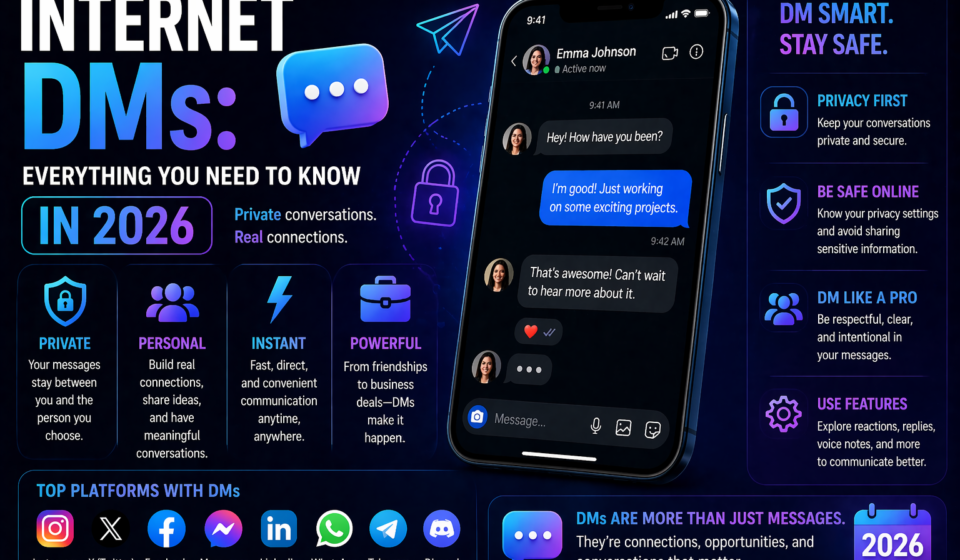
If you spend any time online, you have definitely come across internet DMs. A DM, or direct message, is a private message you send to someone on a social media platform or messaging app. Unlike public posts or comments, internet DMs go only to the person you choose. Nobody else can read them in your feed. They work like a private conversation between two people, or sometimes a small group. Over the past decade, DMs have become one of the most popular ways people connect online. From making new friends to closing business deals, DMs do a lot of heavy lifting in today’s digital world.
What Does DM Mean on the Internet?
The term “DM” stands for Direct Message. It refers to any private, one-on-one (or group) message sent through a social media platform or online communication tool. You might also hear the phrase “slide into someone’s DMs,” which means reaching out to someone privately, often for the first time.
The concept is simple. You see a public profile, You want to talk to that person privately and You send them a DM. They receive it in their private inbox. The rest of the world never sees it. That is the basic idea behind every direct message on the internet.
People also use “DM me” as a call to action. Businesses say it. Content creators say it. Even government accounts say it. It means: reach out to me privately through this platform.
A Brief History of Direct Messaging Online
Direct messaging did not start with Instagram or Twitter. The idea goes back to early internet culture. Here is a quick timeline:
| Era | Platform/Technology | Key Feature |
|---|---|---|
| 1990s | IRC (Internet Relay Chat) | Private chat channels between users |
| Early 2000s | AOL Instant Messenger (AIM) | Buddy lists with one-on-one messaging |
| Mid 2000s | MySpace, Facebook Messages | Social network private inboxes |
| 2010s | Twitter DMs, Instagram DMs | In-app messaging tied to social profiles |
| 2020s | Instagram, WhatsApp, Telegram, Discord | Rich media DMs with voice, video, reactions |
Each generation of internet communication brought new features. Today’s DMs support photos, videos, voice notes, gifs, polls, and even payment links. They have come a very long way from simple text chat.
How Do Internet DMs Work Technically?
You do not need to be a tech expert to understand this. Here is a straightforward breakdown.
When you send a DM, your message travels from your device to the platform’s server. The server checks the recipient’s account. It then delivers the message to their inbox. This all happens in under a second. Most modern platforms use end-to-end encryption for DMs. That means only you and the receiver can read the message. Not even the platform itself can read it, in theory.
Some platforms store messages on their servers. Others delete them after delivery. Some give you the option to set messages to disappear after a set time. Features like read receipts tell you when someone opened your message. Typing indicators show when someone is writing back.
The technical backbone of DMs involves protocols, APIs, and server infrastructure. But from the user side, it feels seamless and instant.
Top Platforms for Internet DMs in 2026
Different platforms offer different DM experiences. Here is a breakdown of the most popular ones.
Instagram Direct Messages
Instagram DMs are incredibly feature-rich. You can send photos, videos, reels, voice messages, and even share posts from your feed directly into a DM. You can also create group chats. Instagram DMs support message reactions and disappearing messages too. Many influencers and small businesses use Instagram DMs to connect with their audience and customers every single day.
Twitter/X Direct Messages
Twitter, now rebranded as X, has a DM feature that lets you message anyone with an open inbox. Previously, you could only DM people who followed you. Now, with X Premium, the rules have shifted. Twitter DMs work well for professional outreach and networking. Many journalists, creators, and brands use them actively.
WhatsApp Messaging
WhatsApp is arguably the world’s most popular DM platform. Over two billion people use it. It uses phone numbers as identifiers. WhatsApp offers end-to-end encryption for all messages by default. It supports text, voice, video calls, file sharing, and group chats. For many users, WhatsApp has replaced traditional SMS messaging entirely.
Telegram
Telegram is a privacy-focused messaging app with powerful DM features. You can send self-destructing messages. You can create secret chats with extra encryption. Telegram also supports massive groups with up to 200,000 members. It is popular among communities that value privacy and freedom of expression.
Discord DMs
Discord started as a gaming communication tool. Today, it is a full-featured social platform. Discord lets you send DMs to any user you share a server with. You can also send friend requests and message people directly. Discord DMs support text, images, videos, and file attachments.
Facebook Messenger
Facebook Messenger is one of the oldest and most established DM tools on social media. It works both inside Facebook and as a standalone app. You can use it to chat with friends, create group conversations, and even make voice and video calls. Businesses use Facebook Messenger chatbots to handle customer service at scale.
LinkedIn Messages
LinkedIn DMs are essential for professional networking. Known as InMail on LinkedIn, private messages let you connect with potential employers, clients, and collaborators. A well-crafted LinkedIn DM can open real career opportunities.
Types of DMs You Will Encounter Online
Not all DMs are the same. Here is a look at the main categories.
Personal DMs: These are casual messages between friends or family. They feel like a private conversation. No professional tone is needed here.
Professional DMs: These go to colleagues, clients, or employers. They need a clear, respectful, and concise tone. Your first impression often lives in that first message.
Business Inquiry DMs: Brands and customers use these. A customer DMs a brand to ask about a product. A freelancer DMs a potential client to pitch their services.
Spam or Promotional DMs: Unfortunately, not every DM you receive is genuine. Many platforms fight spam messages sent in bulk to random users.
Phishing DMs: These are dangerous. They pretend to be someone you trust. They try to steal your login details or money. We will cover how to spot these later.
DM Etiquette: How to Write a Great Direct Message
Writing a good DM is a skill. Poor DMs get ignored. Great DMs get responses. Here are the key rules.
Keep your opening short and clear. State who you are and why you are messaging. Do not write a wall of text in a first message. Respect the other person’s time and space. If someone does not reply, do not send multiple follow-up messages back to back.
Use proper spelling and grammar. Even casual DMs benefit from basic punctuation. Read your message before you send it. Ask yourself: does this make sense to a stranger? Is my intent clear?
For professional DMs, add context. Mention a shared connection or something specific about their work. Generic messages rarely convert. Personalised messages show genuine effort.
Internet DM Privacy and Safety Tips
Privacy is one of the biggest concerns around online messaging. Here is what you need to know.
Always check the privacy settings on each platform. Most apps let you control who can send you DMs. You can often limit DMs to people you follow or people you are connected with. Use this feature. It significantly reduces unwanted messages.
Never share sensitive personal information in a DM. This includes your home address, bank details, passwords, or social security number. Even if the person seems trustworthy, DMs can be screenshotted and shared.
Watch out for phishing scams in your inbox. These messages often claim you have won a prize. They might pretend to be a platform’s official support team. They ask you to click a link or verify your account. Always go directly to the official website instead of clicking links in DMs.
Enable two-factor authentication on all your messaging accounts. If someone does get your login, this extra step stops them from accessing your messages.
Common Internet DM Slang and Abbreviations
The internet loves shorthand. Here are the most common DM-related terms you will see.
| Term | Meaning |
|---|---|
| DM | Direct Message |
| PM | Private Message (older term, same concept) |
| Slide into DMs | Reach out to someone privately |
| DM me | Send me a private message |
| Open DMs | Public inbox, anyone can message |
| Closed DMs | Restricted inbox, limited access |
| Read receipt | Notification that your message was opened |
| Left on read | Message was opened but not replied to |
| Ghost | Stop replying to someone’s messages |
| Spam DMs | Unsolicited bulk messages |
These terms are everywhere in online conversations. Knowing them helps you communicate fluently in digital spaces.
DMs for Business: How Brands Use Direct Messaging
Businesses have discovered that DMs are incredibly powerful for customer engagement. A brand that responds quickly in DMs builds loyalty fast. Customers feel heard. They feel valued. That experience keeps them coming back.
Many brands use automated DM responses to handle common questions. These chatbots reply instantly. They collect customer details and route complex issues to a human agent. This system works well for high-volume businesses.
Influencer marketing often starts in the DMs too. Brands reach out to creators privately. They pitch collaboration deals. They negotiate rates. The whole campaign might be set up through a series of DMs before any public announcement.
Small businesses especially benefit from Instagram and Facebook DMs. These platforms let entrepreneurs respond to customer enquiries 24 hours a day. They can share product photos, process orders, and build relationships, all through the DM feature.
How Internet DMs Have Changed Communication
DMs changed how people interact online in a fundamental way. Before DMs, you had to use email for private online communication. Email felt formal. It had friction. You needed someone’s email address. DMs removed all that friction.
Now you can contact anyone on the same platform with a single tap. The barrier to private conversation dropped dramatically. This shift brought people closer. It also created new social norms and new risks. The ability to message anyone created both opportunity and overreach.
For journalists, DMs became a reporting tool. Sources contact reporters through DMs instead of email. For activists, DMs became an organising tool. For entrepreneurs, DMs became a sales channel. The way we use DMs continues to evolve as platforms evolve with us.
Internet DMs vs Email: Key Differences
Many people wonder when to use a DM versus an email. Here is a clear comparison.
| Feature | Internet DMs | |
|---|---|---|
| Speed | Instant, conversational | Slower, more formal |
| Formality | Casual to semi-formal | Formal |
| Message Length | Usually short | Can be long |
| Attachments | Yes (with limits) | Yes (larger files) |
| Platform-specific | Yes | No |
| Search / Archive | Limited | Robust |
| Professional standard | Growing | Established |
| Spam filtering | Platform-managed | Advanced filters |
The right choice depends on context. For quick questions or relationship-building, a DM works better. For contracts, lengthy discussions, or formal proposals, email is the right tool.
The Future of Internet DMs
The future of direct messaging looks exciting. Platforms are adding AI features to DMs. You might see AI-powered reply suggestions in your inbox soon. Some platforms already offer message translation in real time. This breaks language barriers between users.
Encryption standards are getting stronger. Privacy advocates push for more platforms to adopt full end-to-end encryption by default. Users are becoming more aware of their privacy rights. Platforms respond to that pressure.
Voice and video DMs are growing in popularity. Short video messages, popularised by platforms like Snapchat and Instagram, are now common. They add a personal human touch that text cannot replicate.
Commerce through DMs is also expanding. Instagram and Facebook already let businesses take orders through DMs. In the near future, complete shopping journeys may happen inside a single DM thread.
Conclusion
Internet DMs have transformed the way people communicate online. From a simple private text message to a full multimedia experience, DMs now power personal connections, business relationships, and community building across every major platform. Understanding how they work, which platforms to use, and how to stay safe makes you a smarter and more effective digital communicator. Whether you are networking professionally, connecting with friends, or building a business online, mastering internet DMs is a skill worth having in 2026 and beyond.
Frequently Asked Questions (FAQs)
Q1: What does DM mean on the internet?
DM stands for Direct Message. It is a private message sent between users on a social media platform or messaging app, visible only to the sender and recipient.
Q2: Are internet DMs private?
Yes, DMs are private by design. However, the level of privacy depends on the platform. Apps like WhatsApp use end-to-end encryption, while others store messages on their servers.
Q3: Can someone DM me without following me?
It depends on your platform settings. On most platforms, you can restrict DMs to followers only. By default, some platforms allow anyone to message you.
Q4: What is the difference between a DM and a PM?
Both mean the same thing: a private message to another user. DM (Direct Message) is the more modern term used on social media. PM (Private Message) was common on older forums and platforms.
Q5: How do I know if my DM was read?
Most platforms offer read receipts. You will usually see a small checkmark, eye icon, or the recipient’s profile photo appear below your message once they read it.
Q6: Is it safe to share personal information in DMs?
No. You should never share sensitive personal information like passwords, bank details, or your home address in a DM, regardless of how trusted the person seems.
Q7: What does “left on read” mean in DMs?
“Left on read” means someone opened your message and saw it but did not reply. The sender can tell because the read receipt shows up without a response following it.
Q8: Can businesses use DMs for customer service?
Absolutely. Many businesses use platforms like Instagram, Facebook, and WhatsApp to handle customer enquiries, take orders, and resolve complaints through DMs efficiently.
Q9: What are spam DMs?
Spam DMs are unsolicited bulk messages sent to many users at once, often promoting products, scams, or phishing links. Most platforms have filters to reduce them.
Q10: How can I protect myself from DM scams?
Avoid clicking links from unknown senders. Never share personal or financial details. Enable two-factor authentication on your accounts. Report suspicious messages to the platform immediately.